
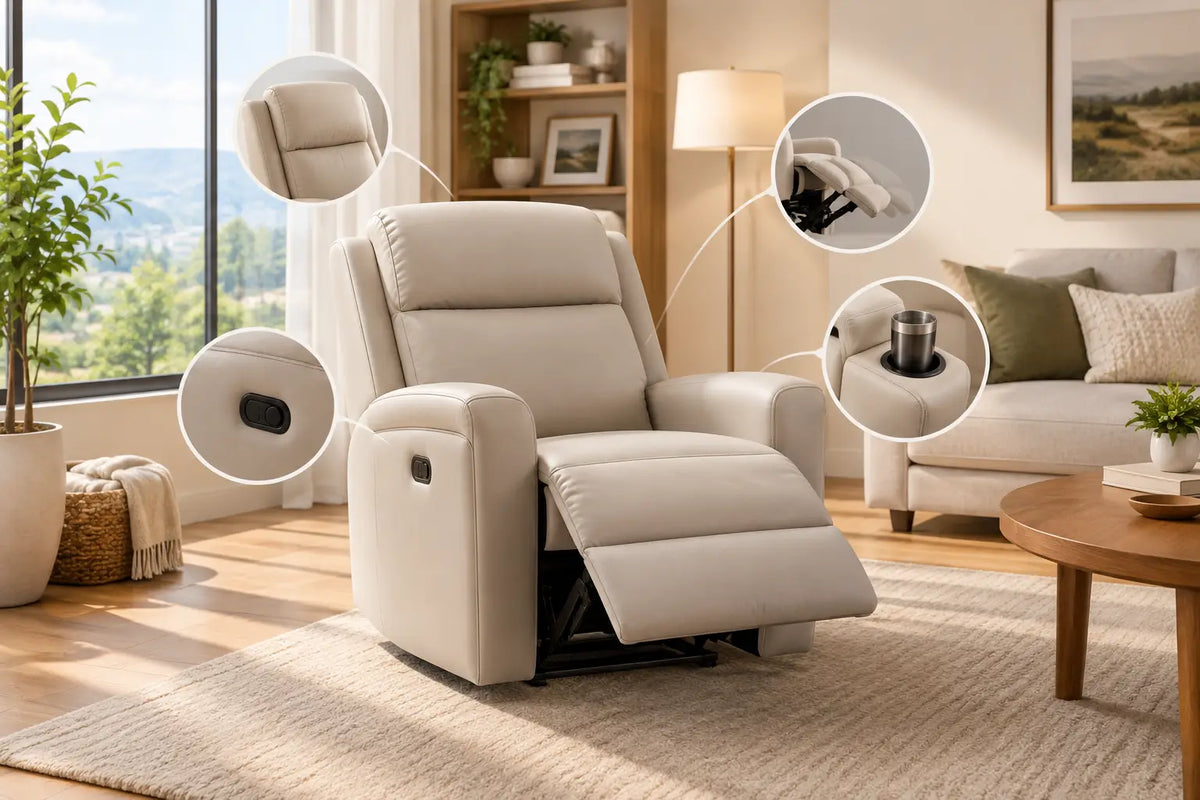
A recliner can be the chair everyone reaches for - or the piece that quietly makes a living room feel crowded, dated, or uncomfortable. Learning how to choose recliner features starts with more than deciding whether you want manual or power motion. The right choice comes down to how you sit, who will use the chair, where it will live, and how the fabric, scale, and mechanism will work with the rest of your home.
Start With the Way You Actually Relax
Before comparing buttons, cup holders, or upholstery swatches, think about your everyday routine. Do you read in the evening, watch movies with the family, take a quick afternoon nap, or need a supportive place to elevate your feet after a long day? A recliner designed for movie nights may prioritize a deep seat and a full chaise footrest. A chair for reading may need firmer lumbar support, supportive arms, and a headrest that keeps your neck in a natural position.
The most comfortable recliner is not necessarily the softest one on the showroom floor. Very plush cushioning can feel inviting at first but may offer less support over a longer sitting session. Conversely, a firmer seat can be more comfortable for people who prefer easier movement in and out of the chair. Sit in each position for several minutes rather than testing it with a quick lean back.
If more than one person will use the chair, consider a middle ground. A power recliner with adjustable headrest and footrest positions can accommodate different preferences well, although it adds cost and requires access to an outlet or battery option.
Choose the Reclining Mechanism First
The reclining mechanism affects daily convenience, placement options, and price. It is one of the first decisions worth making because every other feature builds around it.
Manual recliners
Manual recliners use a side lever, pull handle, or body weight to extend the footrest and recline the back. They are straightforward, often easier to place without worrying about cords, and can be an excellent choice for a secondary sitting area, bedroom, or traditional living room.
The trade-off is less precise positioning. Many manual models offer a limited number of reclining stops, and some require a little leg strength or reach to operate. Test the handle location carefully, especially if mobility or hand strength is a concern.
Power recliners
A power recliner uses buttons or touch controls to move the back and footrest. The movement is gradual and easy to control, which makes it especially helpful for shoppers who want to adjust their position throughout the evening. Some designs allow the footrest to lift while the back remains upright, a practical position for reading or watching television.
Power motion does require planning. Confirm where the nearest outlet is, how the cord will be routed, and whether the room layout supports it without creating a visible tangle. Battery backups or rechargeable power packs can be useful where outlets are limited, but their compatibility and runtime vary by model.
Wall-hugger and space-saving recliners
A wall-hugger recliner is designed to recline with less clearance behind it than a traditional recliner. This can make a real difference in a condo, apartment, den, or narrower living room. It does not mean the chair takes up no extra space when open - the footrest still extends forward - so measure the full reclined depth before you buy.
For an open-plan room, a swivel recliner may also be worth considering. It can make conversation easier and let you turn toward a view, television, or adjacent seating area. Just make sure the swivel base has enough room to rotate without striking a side table or another chair.
Measure Both the Chair and the Room
A recliner’s overall width tells only part of the story. You also need its closed depth, reclined depth, seat height, arm height, and the clearance around it. A generous recliner may look balanced in a large family room but overpower a smaller space beside a compact sofa.
Start by marking the chair’s footprint on the floor with painter’s tape. Include the extended footrest and leave comfortable walking space around the chair. Consider nearby doors, drawers, console tables, and windows. If the recliner will sit near a wall, verify the manufacturer’s recommended clearance rather than estimating.
Seat height matters more than many shoppers expect. A lower, lounge-style seat can feel relaxed and contemporary, but it may be harder for some people to stand from. A higher seat is often easier to enter and exit, particularly for taller adults or anyone who wants a more supportive sit. Your feet should rest comfortably on the floor when the chair is upright, without your knees rising uncomfortably high.
Look for Support Where Your Body Needs It
The best recliner features should improve comfort rather than simply add technology. Pay close attention to lumbar support, the contour of the back cushions, and how well the headrest supports you when reclined.
A power headrest is valuable if you often watch television while reclining. In a standard recliner, leaning back may move your line of sight upward, which can strain your neck. An adjustable headrest lets you bring your head and gaze forward. This feature is particularly useful in media rooms and living rooms where the television is mounted higher on the wall.
Adjustable lumbar support can be helpful for people who prefer a defined lower-back cushion. Still, it is not automatically necessary for everyone. Some shoppers find built-in lumbar too pronounced, so sit with it fully adjusted and then relaxed to see whether it suits your body.
A chaise-style footrest, which provides continuous support from the seat to the feet, usually creates a more lounge-like feel than a separate padded footrest. It is a strong choice for napping and extended relaxation. A divided footrest can offer a more tailored appearance and may better suit a formal room, depending on the chair’s design.
Decide Which Convenience Features You Will Use
Recliners are available with practical additions such as USB charging ports, USB-C charging, storage arms, cup holders, tray tables, heat, massage, and built-in lighting. These can be useful, but extra features should match the room and your habits.
Charging ports make sense beside a favorite reading spot or in a media room where phones and tablets tend to collect. They are less essential in a formal sitting room where a cleaner silhouette matters more. Cup holders and storage consoles can be convenient for home theater seating, but they can make a chair feel more casual and visually substantial.
Heat and massage features appeal to some buyers, yet they also add mechanical complexity. If the goal is a refined, long-lasting living room chair, prioritize the quality of the seat, motion, and upholstery before choosing these extras. A well-built recliner that supports you properly will be used far more often than a feature-packed chair that does not fit your room or body.
Select Upholstery for Real Life, Not Just the Swatch
Recliner upholstery has to handle motion as well as daily wear. As the chair opens and closes, fabric and leather flex at the seat, arms, back, and footrest. Choose a material that suits the household and the level of maintenance you are comfortable with.
Leather offers a polished look, a smooth feel, and easy cleanup for many everyday spills. It can develop character over time, though it may feel cool initially and can show scratches in homes with pets. Performance fabrics are a practical option for busy households because many are designed for easier cleaning and resistance to everyday wear. Their texture can also soften the look of a larger recliner.
Color deserves equal attention. A warm neutral can help a recliner blend into an existing room, while charcoal, navy, cognac, or deep green can make it feel intentional as an accent piece. Bring fabric samples home when possible and look at them in morning, afternoon, and evening light. A color that looks elegant under showroom lighting may read very differently beside your flooring, wall color, and windows.
Match the Style to the Rest of the Room
A recliner no longer has to look like a bulky, overstuffed chair. Contemporary designs can have clean track arms, tailored cushions, slim metal legs, or a compact profile. Traditional rooms may call for rolled arms, nailhead details, or warmer leather tones. The important point is proportion: the chair should relate to the sofa, rug, and tables around it.
If your living room is formal or design-led, look for a recliner with a hidden or discreet footrest and a tailored back. If comfort is the main priority in a family room, wider arms and deeper cushions may be welcome. Neither approach is better. It depends on whether the recliner is meant to disappear into a coordinated seating plan or become the room’s favorite personal seat.
Test the Details Before You Commit
When you visit a showroom, open and close the recliner several times. Listen for unusual noise, notice whether the movement feels smooth, and check whether the controls are easy to reach. Sit upright, partially reclined, and fully reclined. Pay attention to whether your shoulders, lower back, and calves feel supported in each position.
Ask about the frame, motion mechanism, upholstery care, warranty coverage, and power requirements for the specific chair you are considering. Those details can vary widely between models. It is also wise to measure your entryway, stair turns, elevator, and room path before arranging delivery.
For Orange County shoppers, R&R Furniture Gallery in Fountain Valley offers the advantage of seeing scale, comfort, and upholstery in person before making a final decision. A few unhurried minutes in the right recliner can tell you more than a long list of features ever will.