
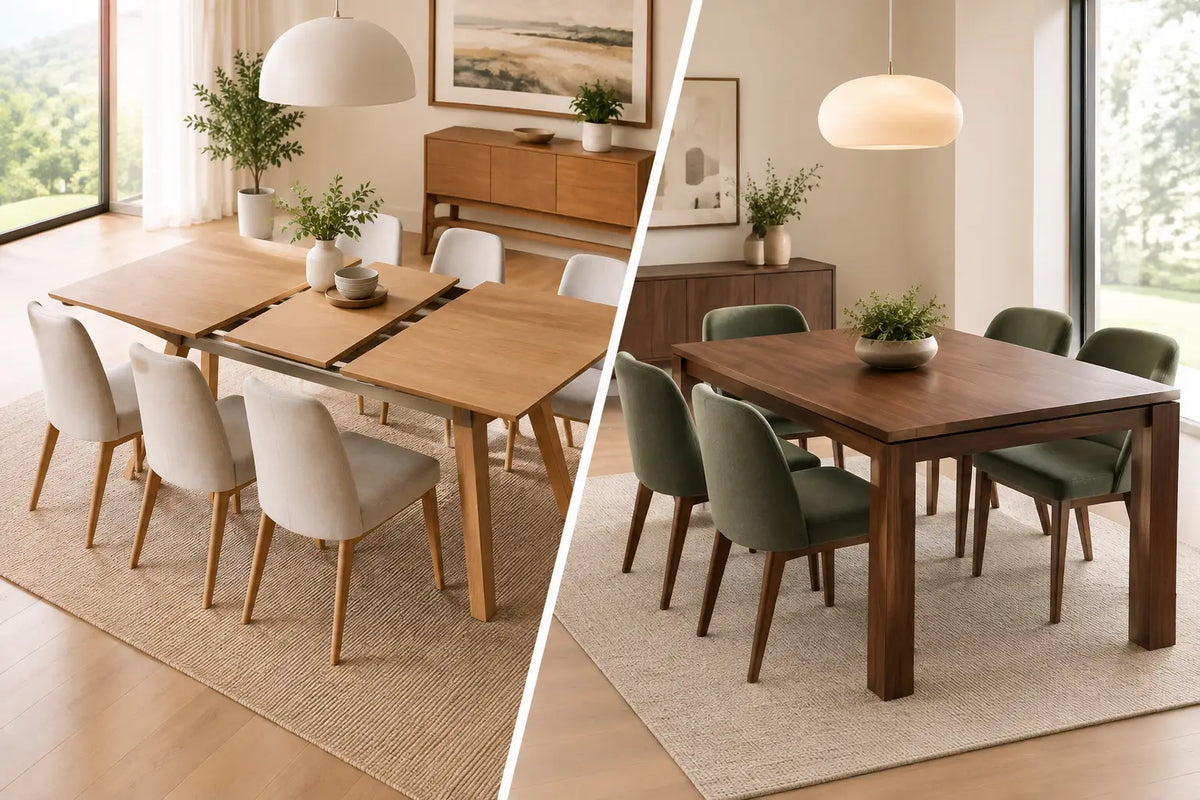
A dining table can look perfectly proportioned in a showroom, then feel too large once it meets your walkways, dining chairs, and everyday routine. The choice between an extendable table versus fixed table is less about which one is better and more about how your home actually hosts, eats, works, and gathers.
For some households, a fixed table creates the clean, tailored dining room they have wanted for years. For others, an extension table solves a very real problem: keeping a room open on an ordinary Tuesday while having enough seating for visiting family on a holiday weekend. The right answer comes down to room dimensions, guest frequency, style preferences, and how much flexibility you want from a central piece of furniture.
Extendable Table Versus Fixed Table: The Core Difference
A fixed dining table has one permanent size. Its tabletop does not expand, so the footprint you see is the footprint you live with every day. This makes planning straightforward. Once you have allowed enough space for chairs and circulation, you know exactly how the dining area will function.
An extendable table is designed to grow when needed. Depending on its construction, it may use removable leaves, self-storing leaves, a butterfly leaf, or a mechanism that opens the table from the center. In its compact form, it can preserve valuable floor space. When extended, it offers additional room for place settings, serving dishes, and extra guests.
Neither construction is automatically more refined or more practical. A beautifully made fixed table can bring a sense of permanence to a formal dining room, while a thoughtfully designed extension table can feel equally polished and much more adaptable for a busy household.
When an Extendable Dining Table Makes Sense
An extendable table is often the smarter choice when your daily seating needs are modest but your entertaining needs are not. A couple may comfortably use a table for four most of the year, yet regularly welcome adult children, friends, or relatives for dinner. Keeping a large table open at all times can make the room feel crowded, especially in a condo, townhouse, breakfast area, or open-plan living space.
Flexibility is the primary benefit. Closed, the table can support everyday meals without overwhelming the room. Open, it gives you a more generous surface for celebrations, game nights, homework sessions, or a meal where everyone can stay at the table a little longer.
Extension tables also suit households whose needs may change. A first home, a growing family, or a newly remodeled space can evolve quickly. Choosing an adjustable dining table may prevent the need to replace it simply because you need two more seats a few times each year.
There are trade-offs. You will want to understand where leaves are stored, how easily the mechanism operates, and whether the expanded shape works with your dining chairs. A leaf stored separately requires a safe, dry place when it is not in use. A self-storing design is convenient, but the table may have a more complex base or apron. If you expect to extend the table often, try the mechanism in person before deciding.
Measure for the table in both positions
The most common mistake is measuring only the closed size. Plan for the table at its full extension, including chairs pulled out from the edge. As a general guideline, leave about 36 inches between the table edge and walls, cabinetry, or other furniture where possible. This gives guests space to sit and lets people move through the room without squeezing behind occupied chairs.
If the room cannot comfortably accommodate the table when extended, that does not necessarily rule it out. It simply means you should be realistic about when and where it will be used at full length. In some homes, moving a console table or temporarily shifting a chair is reasonable for holiday dinners. In others, it quickly becomes an inconvenience.
Why a Fixed Table Can Be the Better Long-Term Choice
A fixed table works especially well when you already have enough space for the number of people you seat most often. If six people dine together several nights a week, a permanent table for six may be far more comfortable than repeatedly opening and closing an extension mechanism.
The visual simplicity is another advantage. Fixed tables often have uninterrupted tops, consistent grain patterns, and silhouettes that are easier to appreciate from every angle. That can matter in a formal dining room or in an open-concept home where the dining table is visible from the kitchen and living area.
A fixed table may also offer more freedom in base design. A substantial pedestal, sculptural base, or artisan-crafted trestle can create a strong focal point without needing to accommodate moving parts. This is particularly appealing to shoppers who see their dining room as a finished design statement rather than a multipurpose zone.
That said, bigger is not always better. A table that technically fits can still make a dining room feel tight, block a path to the patio, or leave too little space for a buffet or sideboard. A fixed table should feel intentional, not like furniture that was forced into the room.
Consider the Shape Before You Choose the Mechanism
Table shape affects circulation and seating as much as extension capability. A round table is naturally conversational and can be an excellent choice for smaller square rooms. Many round designs extend into an oval, offering extra seats while retaining a softer visual profile.
Rectangular tables are familiar, efficient, and usually the easiest shape for larger groups. They work well in long dining rooms and can pair beautifully with upholstered side chairs, benches, or host chairs. A rectangular extension table is often the most practical option for families who entertain at a larger scale.
Oval tables soften the look of a long room and eliminate sharp corners, which can be useful in tighter passages. Square tables create an intimate arrangement for four, but they can become quite large when sized for six or eight. In a compact home, the extra corners may make movement harder than expected.
The base matters, too. Pedestal tables can make flexible seating easier because there are no legs at the corners competing with chair placement. Trestle and leg tables can provide a more architectural look, but check where the supports sit once leaves are added. The best table is one that seats real people comfortably, not just the number listed in a product description.
Match the Table to How You Really Live
Before falling in love with a finish or silhouette, think through an ordinary week. Is the dining table used for morning coffee, remote work, school projects, and dinner? Or is it reserved for planned meals and special occasions? A table that serves as a daily work surface may benefit from a fixed, consistently sized top. A table used mainly for meals and entertaining may benefit more from the versatility of an extension design.
Also consider maintenance. Light finishes, high-gloss surfaces, natural wood, glass, and stone-look tops each respond differently to fingerprints, spills, heat, and daily wear. Families with young children may prioritize an easy-care finish and comfortable seating over a more delicate surface. Design-conscious homeowners may be willing to take extra care in exchange for the visual impact of a distinctive top or detailed base.
Chairs deserve the same attention. Measure chair width, account for armrests, and avoid assuming that a table’s maximum seat count will work with every chair style. Upholstered dining chairs generally require more breathing room than slim wood or metal designs. If you are mixing chairs with a bench, confirm that the base allows the bench to slide in easily.
A Practical Way to Decide
Choose an extendable table if your room needs to stay open most days, you host people several times a year, or your household size may change. It is a practical investment in flexibility, provided the extension system feels easy to use and you have planned for the table at full size.
Choose a fixed table if you use the same seating capacity frequently, have a dedicated dining room with generous clearance, or value a permanent, sculptural look. It can make daily dining simpler and give the room a composed, grounded presence.
At R&R Furniture Gallery, seeing dining tables in person can make this decision much easier. Bring your room measurements, a few photos of the space, and an honest idea of how many people you seat on a normal day and on your busiest one. A table should not only photograph beautifully - it should leave room for the life happening around it.